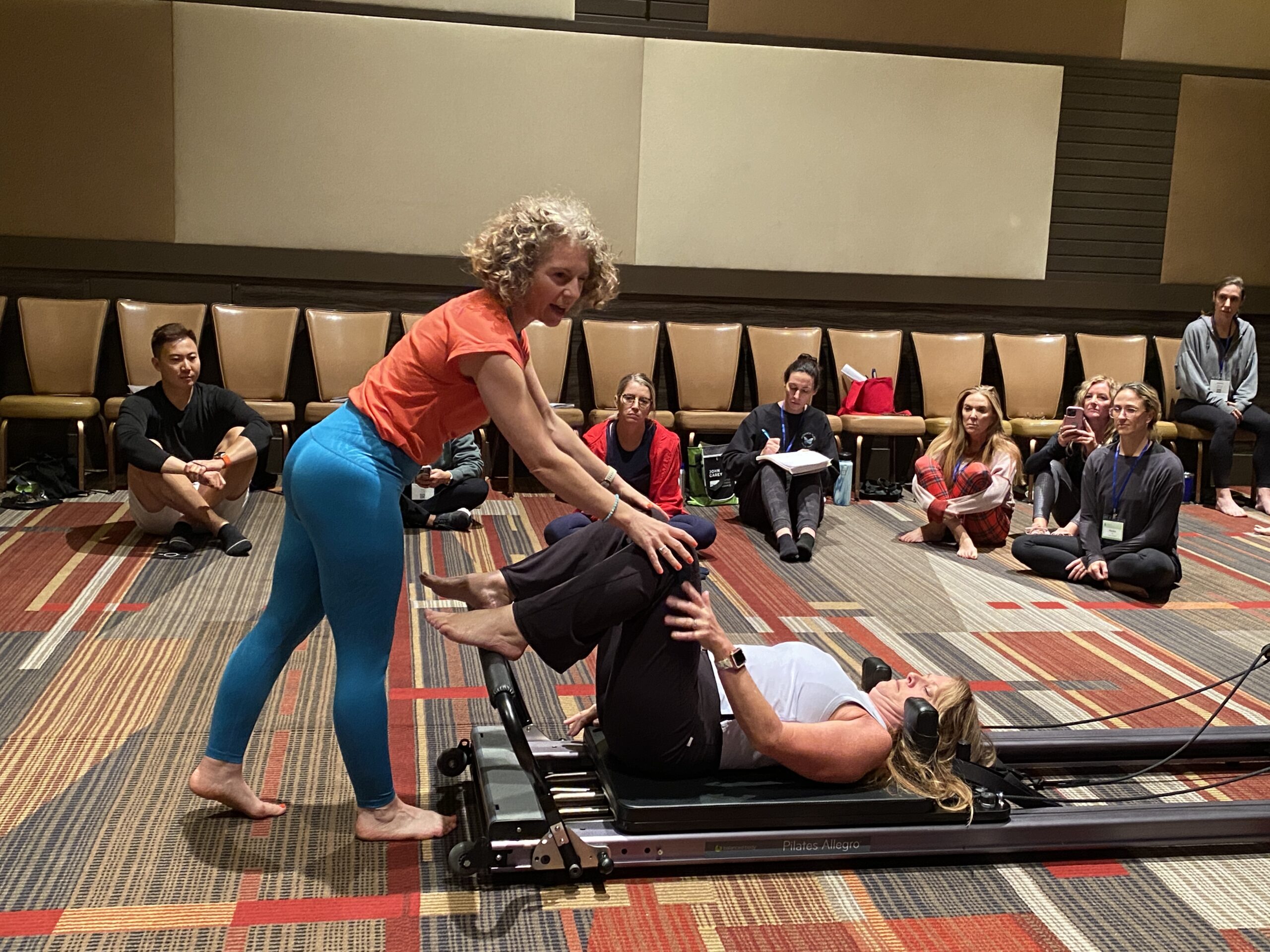


In all my travels, teaching at conferences and teaching teachers online, the same sentence keeps coming up. “My training didn’t include…” The jump board. The foot corrector. The Ped-o-pul. That one prop everyone else seems to use.
No training can include everything. That isn’t a failing. But the gaps are worth filling on purpose rather than by accident.
So this is the first in a short series: what a piece of equipment is, and why it’s worth integrating. We start with the jump board.

When teachers tell me why they don’t use it, the reasons are practical. Not every studio has one. There isn’t time. It’s a faff to set up. Clients came for Pilates, not cardio. And underneath most of those is one assumption: it’s just cardio.
It is a lot more than cardio. These are the reasons I give my own studio clients, and they’re your answer to the client who came for Pilates, not cardio.
Feet. On the foot bar, the foot meets a narrow bar. On the jump board, the whole sole meets a flat surface. Clients can feel heels, balls of the feet, each toe. Feet are full of sensors that tell the brain where we are in space, and most of us spend all day in shoes that dull them.
Balance. Balance draws on the eyes, the inner ear and the feet. Feet that are mobile, responsive and strong help clients stay steady, and walk, run and climb for longer.
Power. Jumping trains the ability to produce force quickly and land softly. That fades with age faster than strength does, and slower Pilates work doesn’t touch it. It’s part of what helps when someone catches a toe on a kerb and has a split second to recover.
Impact, dialled. Lying down, with springs setting the load, you can introduce impact to clients who aren’t ready to jump against gravity. After a joint replacement, once cleared. With osteoarthritis. Coming back to running after surgery or a baby. Building towards the loading that bones respond to. It’s a rung on the ladder, not a substitute for it.
Pelvic floor and abdominals. On her back, the pelvic floor and abdominals can learn to respond to impact before they have to do it upright. It’s a stepping stone back to running, skipping and jumping, and a quiet way in for the client who leaks when she jumps and has been avoiding it.
Fitness. Yes, it raises the heart rate. That’s not a reason to leave it out. It’s cardiovascular fitness built with the same attention to quality as everything else you teach.
Fun. Play isn’t a break from the work. Clients who enjoy something come back to it.
The first jump can feel daunting, for the client and for you. So don’t start with jumping.
Start with footwork on the jump board, rehearsing for the jumps to come. Keep the feet flat for as long as possible. As the legs reach full extension, lift the heels. Keep them lifted as you bend. Then press the heels down to press out again. That is a jump in slow motion.
Once it’s clean in parallel, take it into Pilates V, wide, and single leg.
When you’re ready to jump, lighten the springs. I use two reds and a blue for footwork, then one red and one blue for mini jumps. Start by alternating: one jump, one footwork press. Raise the headrest first so it doesn’t hit the end of the frame.
The jump sets up the landing, and the landing is where things go wrong. A client who hasn’t taken off through her feet comes down on flat feet with jarred knees.
That’s why the slow-motion footwork comes first. The landing is the take-off in reverse: toes, ball, heel, knees softening. If she can articulate on the way out, she can land on the way back.
Watch the breath too. A client who holds her breath to jump is showing you how she manages pressure.
The slow-motion jump works on the foot bar too. You lose the whole-foot contact, but you can still teach the articulation the landing depends on. When you do get one, your clients will be ready.

Next in the series: the equipment and props you tell me your training left out. If you’d like the next instalment in your inbox, subscribe to my teacher newsletter here.
I also write for my studio clients at Chapel Allerton Pilates. If you’d like to see how I talk to my own community, you can subscribe here.
And if the Ped-o-pul is your gap, my workshop is here.
Claire
Let’s stay in touch?
next real online class 20th November